Case Studies

Connecting the Red River – Landowner Engagement for Nature Recovery 

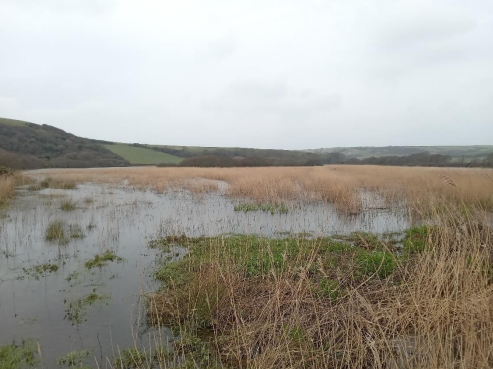
The Red River Valley in Cornwall, once known as the most polluted river in the region due to its mining legacy, is now a focal point for environmental restoration. The valley, which forms the southern boundary of the Godrevy to Portreath section of the Cornwall National Landscape (AONB), is a mosaic of habitats and land uses, including council-owned nature reserves and privately owned agricultural land, scattered with relics of the mining heritage and earlier history alongside the canalised (artificially straightened) river channel. 

In 2022, Cornwall Council and the Environment Agency developed a comprehensive Vision Plan for the Red River, identifying opportunities for nature recovery, flood resilience, public access, and economic revitalization. However, deeper, more meaningful engagement with the farming community remained a further goal as a key stakeholder group for a connected landscape approach.

The Farming in the Protected Landscape (FiPL) programme funded a landowner engagement project that successfully involved at least 15 landowners across 500 hectares in the lower Red River Valley, taking eight farmers forward to develop detailed farm opportunity reports. The engagement aimed to raise awareness of nature recovery opportunities, promote sustainable land management, and encourage collaborative, landscape-scale environmental action. It achieved this through one-on-one farm visits, opportunity reports, and the promotion of nature-based solutions such as wetland restoration and floodplain reconnection. Additionally, the project facilitated knowledge exchange via expert-led site visits and demonstration farms, supported economic diversification through regenerative tourism and local branding, and laid the groundwork for future collaboration.:  

Within the opportunity reports habitat restoration was key for everyone. Interventions such as species-rich grassland restoration, wetland and pond creation, and coastal grazing marsh restoration were identified for farmers which could be funded through schemes such as Countryside Stewardship, SFI and FiPL. These habitat scale interventions were then complemented by smaller scale interventions such as the replanting of historic field boundaries and the creation of leaky dams.    

The project also emphasised public access improvements, including the extension and connection of public rights of way (PROW), and diversification ideas such as educational farm visits. Collectively, these opportunities reflect a holistic approach to landscape-scale conservation and sustainable agriculture and the FiPL team welcome any farmers that have taken part in the Red River project to keep in touch if there are any interventions for which they seek funding.

top border