Monitoring & Evidence
Our objectives can be achieved through various means such as but not...
View page
Cornwall National Landscape comprises varied landscapes whose distinctive characters, natural beauty and unique settlements, including rural, industrial and coastal heritage, are so outstanding that it is in the nation’s interest to safeguard it. The team at Cornwall National Landscape provides advice to Cornwall Council on planning matters in the protected landscape.
The statutory purpose of the designation is to conserve and enhance the natural beauty of the area. Notwithstanding this protection, these landscapes are shaped by and inextricably linked to the lives and vitality of the communities within them and development needs to be shaped to reflect this within the confines of the protection afforded to them. To maintain Cornwall National Landscape’s distinctiveness, development should be landscape-led, to contribute to the sense of place; it should respond to local historical, cultural and landscape context and enhance and feel part of the existing settlement and landscape.
The Management Plan defines what we mean by natural beauty and describes the special qualities of its 12 unique sections. This document is a material planning consideration and is designed to help Local Planning Authorities, developers and land/homeowners understand the landscape’s capacity for change and assess impact. Mitigation is a response to harm, a way of ameliorating but not eliminating impact, and should not be a justification for allowing inappropriate development. A clear understanding of the National Landscape’s special qualities and distinctive characteristics will help to develop proposals which avoid harm and deliver enhancement.
Cornwall Council is the local planning authority. They receive all planning applications and make decisions on the outcome. Cornwall National Landscape are a non-statutory consultee to planning matters within, or affecting, the designated protected landscape. The statutory consultee for planning matters affecting Cornwall National Landscape is Natural England.
Cornwall National Landscape do not have enforcement powers.
Our duty is to champion and promote the conservation and enhancement of the natural beauty of the Cornwall National Landscape and to help Local Planning Authorities and other public bodies to further this purpose under s85 of the Countryside and Rights of Way Act 2000.
Our role is to provide Planning, and related, advice on Local Plans, Neighbourhood Development Plan, Planning applications and Pre-application consultations made to Cornwall National Landscape. However, we are a small team and therefore have to be selective about which planning matters (planning applications) we get involved in to direct resources where they are most needed.
The Cornwall National Landscape promotes sustainable development prioritises sustainable planning practices that protect and enhance the natural beauty, cultural heritage, and unique character of the region.
Are you seeking assistance with planning applications in an AONB area? Our team is here to support you through the process.
Sorry we're not taking pre-applications at the moment, please check back soon.
Are you seeking assistance with planning applications in an AONB area? Our team is here to support you through the process.

Find out more about our team, partnership and our primary purpose to conserve and enhance natural beauty

Inspiring all who live, work and visit the protected landscape

Aligning with Global, National and Local Strategies
The Key Landscape Characteristic of this section of the AONB is a high coastal plateau of carboniferous sandstones and slates known as the Culm Measures. The cliffs are sheer; reaching 140m in some places and are intensely folded and faulted. The sea has sculpted a striking wave-cut platform, which at low tide reveals a rock stratum of folded and faulted ridges. These shores are punctuated occasionally by sandy coves and beaches at the mouths of stream valleys, notably at the aptly named Sandymouth.

The Key Landscape Characteristic of this section of the AONB is the coastline, which throughout this section is craggy with dramatic contorted cliffs and folded slates, shales and volcanic rocks with some sandstone to the north.

The Key Landscape Characteristic of this section of the AONB is defined by its distinct, gentle, undulating land sloping down into the broad Camel valley.

The Key Landscape Characteristics of this section of the AONB are the variety of coastal scenery due to the diverse geology including hard greenstones, which form the elevated headlands as seen at Trevose Head and Stepper Point.

The Key Landscape Characteristic of this section of the AONB is the dominant large granite intrusion that forms the distinctive St Agnes Beacon, which rises from the surrounding undulating coastal plateau (formed of slate killas) to a height of approximately 90m above sea level.

The Key Landscape Characteristics of this section of the AONB are its sheer cliffs of unstable, soft, gritty slate – constantly eroded by the unrelenting power of the Atlantic Ocean, as seen at Hell’s Mouth and Hudder Cove and are referred to as ‘North Cliffs’.
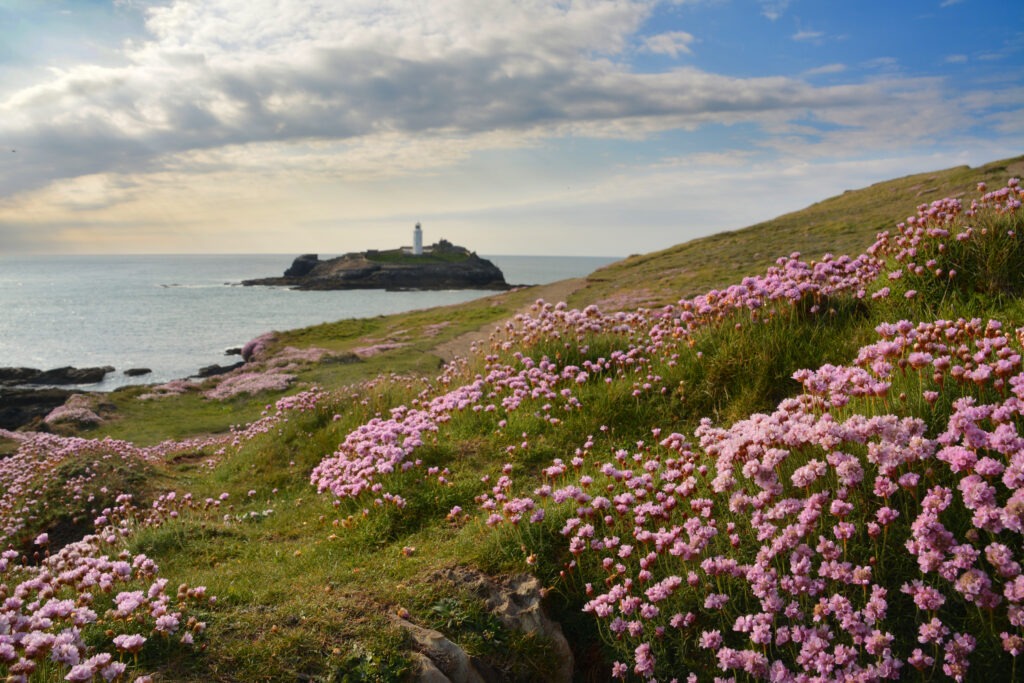
The Key Landscape Characteristic of West Penwith is shaped by its granite geology and geographical position at the end of the land – exposed to the full force of the Atlantic Ocean.

The key landscape characteristics of the coastal landscape in this area of the AONB is a soft profile. It benefits from the protection offered by the Penwith peninsula against the full force of the Atlantic storms.

This area shares similar landscape characteristics to the Helford River and estuary as described in Section 8, South Coast Western, but on a much larger scale.

The Key Landscape Characteristics of this section of the AONB can be split into two distinct areas: Fowey Ria and Polperro Coast.

The Key Landscape Characteristic of this section of the AONB is Rame Head which forms a southerly point at the extreme east of Whitsand Bay, which sweeps in a wide arch west to Portwrinkle.

The Key Landscape Characteristics of this section of the AONB is a distinctive upland landscape which is created from the underlying granite mass, the largest of several granite intrusions that penetrate the slate killas bedrock along the spine of Cornwall.


The Cornwall AONB is protected by statutory requirement, planning policy and material considerations which require the conservation and enhancement of the natural beauty of the AONB landscapes.
Great weight should be given to conserving the landscape and scenic beauty of the designated landscape which enjoys the same level of protection as a National Park.
Priority




Aim
To ensure development conserves and enhances the local distinctiveness and natural beauty of the AONB landscapes and their settings while meeting the needs of local communities. Development within the designated landscape should be demonstrably “landscape-led” to allow it to provide a contextual response to its specific setting within the AONB, clearly addressing locally characteristic forms of development in terms of scale, massing, form, architectural treatments, distinctiveness, respect to local heritage, biodiversity and other key attributes of the local landscapes.
Development should conserve and enhance and feel part of the existing landscape and settlement pattern and form. This can include responding to both built and natural attributes, for instance reflecting vernacular construction methods, built forms, field patterns and landscapes. It may also include retaining or enhancing key views, landscapes and buildings that provide a tangible link to Cornish culture as well as ensuring that local place names and character are understood and form part of the development proposals.
Code: PD-P1
All development within the AONB will be required to adopt a “landscape-led” approach as set out within this document in order to conserve and enhance the natural beauty of the AONB.This approach will provide for the statutory protection of the AONB landscapes and will deliver the policy requirements that stem from this. Development proposals within the AONB landscape will be required to demonstrate a contextual understanding and response to the unique and characteristic attributes of the site and its setting and to demonstrate how the proposed development positively responds to these in conserving and enhancing the designated landscape.
Provided that this does not impact upon the qualifying features of the SAC or SPA from land take or changing land use.
Code: PD-P2
Development management decisions should specifically consider the cumulative effects of individual developments on the designated landscape. The addition of further individual developments and particularly replacement and redevelopment of existing dwellings and buildings and the extension of settlements will be supported where these are landscape led and do not exceed the sensitivity and capacity of their designated landscape setting and where they do not give rise to cumulative effects particularly through the inclusion of uncharacteristic contemporary elements, domestic paraphernalia and light spill. The unique historic character of many of the settlements and clusters of dwellings in the designated landscape reflect both their vernacular form and buildings and also their relationship to their landscape setting. The loss of either characteristic will be disproportionately harmful.
Code: PD-P3
The replacement and redevelopment of existing dwellings will be supported where the overall scale, density, massing, height, layout, materials and landscaping of the development appropriately responds to local character and natural beauty of the surrounding AONB landscape. Such development should be broadly comparable to the size, scale and bulk of the dwelling being replaced, and not adversely affect the character of the surrounding area.
Code: PD-P4
“Major development” should be refused in the Cornwall AONB subject to the tests set out in NPPF para 177. This Management Plan, at Appendix ii, sets out the views of the AONB Partnership as to what should be considered to constitute “major development” in the AONB.
Code: PD-P5
Seek to embed the statutory purposes of the AONB designation and AONB Management Plan policies, and requirement for a landscape-led approach in the all relevant Cornwall Council and other stakeholder plans, policies, strategies and programmes.
Code: PD-P6
Support appropriate characteristic green infrastructure within built development and the wider landscape, where this would follow the required landscape-led approach required for the AONB.
Code: PD-P7
Support small scale developments that enable the identified needs of local people to be met in terms of provision of affordable housing, maintaining and enhancing local community amenities and services. Housing need and affordable housing need within the AONB should be based on robust evidence of local need arising from within the AONB. The extent to which the AONB is required to accommodate objectively assessed needs arising from outside the AONB should be limited. Any such development should be in sustainable locations with good access to services where landscape capacity and opportunity to conserve and enhance the protected landscape can be demonstrated. Exception sites for affordable housing related to any settlement within the AONB should be identified in the light of a “landscape-led” comparative analysis of alternative sites to ensure that only the most appropriate sites are brought forward.
Provided that this does not impact upon the qualifying features of the SAC or SPA from land take or changing land use.
Code: PD-P8
Support new tourism, leisure and recreation development that conserves and enhances the diverse local landscape characteristics of the various sections of the Cornwall AONB. Development of such facilities should respond to the character, sensitivity and capacity of the designated landscape and not comprise a conspicuous uncharacteristic element harming the character, tranquillity and biodiversity of the landscape, ensuring that the scale, design, colour, and use of materials have appropriate regard to the protected landscape. Seek better integration of existing holiday sites, visitor infrastructure, and car parks in order to reduce landscape and visual impact.
Provided that this does not impact upon the qualifying features of the SAC or SPA from recreational disturbance.
Code: PD-P9
Support the sustainable management of recreational water sports, and commercial and operational maritime activities including shell fisheries and dredging in AONB estuaries and at the coast. Recognise the potential harm to tranquillity and biodiversity from both recreational and commercial and operational maritime activity both within the enclosed waters of the designated landscape and also the marine areas which form their setting.
Support measures to conserve and enhance the AONB coast, including safeguarding currently undeveloped coastal stretches. Provided that this does not impact upon the qualifying features of the SAC or SPA from recreational disturbance.
Code: PD-P10
Support appropriate landscape-led site selection and design of new telecommunication and power infrastructure. Require such development to comply with the Code of Best Practice on Mobile Network Development in England (or any successor document).
Code: PD-P11
Any development in, or within the setting of, the AONB must be sustainable development that:
Particular care should be taken to ensure that development outside the AONB does not harm the natural beauty, character and special qualities of the AONB and/ or its setting or otherwise prejudice the achievement of the AONB purposes. The AONB enjoys equal protection from effects whether they result from development within or outside the designated area.
Provided that this does not impact upon the qualifying features of the SAC or SPA from land take or changing land use.
Code: PD-P12
Quarrying and mineral extraction within the AONB or within its setting should conserve and enhance the landscape character and natural beauty of the area. Support the landscape restoration of existing mines and quarries, to enhance landscape character and natural beauty by seeking appropriate new planning conditions through the Review of Mineral Planning Permissions. Support existing small-scale quarries within the different sections of the CAONB, in order to allow controlled production of characteristic stone for use locally to facilitate contextually responsive development. These quarries will be required to respect landscape character, topography and vegetation in their operation and restoration and minimise short- and long-term landscape and visual impacts. Support further measures to protect and enhance environmental and landscape quality when existing quarrying permissions are reviewed.
Provided that this does not impact upon the qualifying features of the SAC or SPA from land take or changing land use.
Code: PD-P13
Support the use of local vernacular stone and other building materials used in vernacular ways within built development and infrastructure. If necessary, by the small-scale and sensitive reworking of local quarries.
Code: PD-P14
Renewable energy technologies and associated infrastructure, both onshore and offshore, should be of a scale and design able to be accommodated within the AONB and its setting. Any such development should adopt landscape led principles to guard against landscape, visual and cumulative impacts, in accordance with the evidence base contained within the local relevant renewable policies.
Provided that this does not impact upon the qualifying features of the SAC or SPA from land take or changing land use.
Code: PD-P15
Built development should provide gains for biodiversity; promoting habitat retention, creation, enhancement and species protection aligned with other relevant policies.
Provided that this does not impact upon the qualifying features of the SAC or SPA from land take or changing land use.
Code: PD-P16
Any development within the marine, coastal and estuarine environment must take account of terrestrial and marine based planning policies and processes.
Provided that this does not impact upon the qualifying features of the SAC or SPA from land take or changing land use.
Code: PD-P17
Farm diversification and infrastructure will generally be supported where they provide sustainable rural businesses, enhance local distinctiveness and cultural heritage and where the development is of a scale, design and location that can be accommodated within the sensitive landscapes of the AONB.
See Appendix i.
Code: PD-P18
The conversion of existing redundant agricultural (and other similar)buildings to form dwellings will only be supported where:
• The existing buildings are characteristic, historic, vernacular buildings which are recognisably an important part of the local built and landscape context; and
• The existing buildings are worthy of retention in their own right; and
• The conversion very substantially retains the scale, character and appearance of the original building with repair generally preferred to renovation; and
• The conversion does not give rise to the introduction of uncharacteristic fenestration or domestication of the setting or the introduction of conspicuous domestic paraphernalia into the setting of the building.
The conversion of redundant existing agricultural (and other) buildings such as pole barns, simple concrete block barns or portal frame buildings which in the absence of an agricultural use would form alien elements in the landscape will not generally be supported.
Avoids impacts upon the qualifying feature of the SAC and SPA from land take or changing land use.
Code: PD-P20
Require the conservation and enhancement of the existing character of the local road network and particularly the minor lanes within the designated landscape. The pattern and character of the roads of much of the designated landscape contributes appreciably to the character of the area, from sunken and enclosed lanes in wooded valleys to open unenclosed moorland roads. Changes to the roads and lanes in the designated landscape require particular design to ensure that their characteristic form is not lost or compromised. Widening, straightening, re-routing, kerbing and enclosure of currently unenclosed sections or the inclusion of uncharacteristic standard suburban details and particularly the proliferation of signage should be avoided. New openings to lanes through existing hedge banks or vegetation which require uncharacteristic contemporary design standards and uncharacteristic visibility splays will not be supported. Where new highway works are required these should adopt traditional approaches including locally appropriate Cornish hedge banks and where appropriate characteristic soft passing places and should reflect characteristic local landscape patterns and boundaries. The management of verges should provide opportunity for biodiversity net gain.
Code: PD-Ob1
Support the preparation of Neighbourhood Development Plans by Cornwall AONB parishes, in the light of robust landscape evidence bases, promoting the conservation and enhancement of local landscape character and distinctiveness.
Code: PD-Ob2
Seek opportunities to reduce and remove existing overhead power and telecommunications lines via the Ofgem Undergrounding and other programmes in order to reduce landscape and visual impact.
Where/if the overhead cables are in proximity to a Habitats site that there may be a potential impact pathway through direct land take if the undergrounding route were to transit through the Habitats site. A project-level HRA screening at application stage may therefore be necessary
Code: PD-Ob3
Promote a pragmatic approach for coastal communities to accommodating the effects of climate change including the relocation of infrastructure and facilities where this is compatible with the primary purpose of the designation and other policy requirements.
Code: PD-Ob4
Any development should consider the relative carbon balance between the options of new build or refurbishment with a strong preference for the lowest carbon options considering the balance between embedded carbon and operational carbon emissions and preferring low carbon materials and construction methods.

A collection of. links that may help you find the information you need when planning a development in an AONB
The online planning register helps you find, view and make comments on any planning applications. Alerts can be set up to notify you of any planning applications in your area.
Building Regulations apply to most building work. It is important to find out if you need permission.


Prince of Wales Mine by Ainsley Cocks, courtesy of Cornish Mining World Heritage Site

006Boscastle – Myra Kavanagh

A diamond landscape where the crew are ready for the call to save lives at sea.

A shared strategy for those who live, work and visit the Cornwall National Landscape (AONB). It provides guidance to help Government, statutory organisations and any public body to ensure they are fulfilling their Section 85* duty to ‘have regard to the purpose of conserving and enhancing the natural beauty’ of the protected landscape.