Monitoring & Evidence
Our objectives can be achieved through various means such as but not...
View page
The Cornwall National Landscape is made up of 12 separate geographical sections. This week is a spotlight on Section 08, South Coast Western of the Cornwall National Landscape. This section...
The Cornwall National Landscape is made up of 12 separate geographical sections. This week is a spotlight on Section 08, South Coast Western of the Cornwall National Landscape. This section is large, wide-ranging and diverse, extending from Marazion in the west to the outskirts of Falmouth (Maenporth) in the east and includes the entire Lizard Peninsula and the Helford Estuary.
A truly captivating section where natural beauty meets ancient legacy. This is a living mosaic of windswept headlands, rich biodiversity, and layers of geological time etched into the cliffs. From Iron Age hillforts to rare heathland habitats and dramatic coastal formations, Section 08 tells a story that spans millennia.
“Section 08 is a landscape of dramatic contrasts from the soothing, sheltered, wooded shoreline of the Helford River to the rugged and imposing coastline of the Lizard Peninsular. The ever-changing seascapes here have shaped my adventures and grounded me in a landscape which has always been my constant.” says Louise Barattini, Planning Officer, Cornwall National Landscape team.
Here, the landscape isn’t just something to admire. Every rock, ruin, and ripple in the land reflects a deep connection between people and place. We can explore how the land’s unique geology shaped both its ecosystems and its history, and why habitats such as wildflower meadows are so ecologically valuable, and how community efforts are helping preserve this irreplaceable heritage.
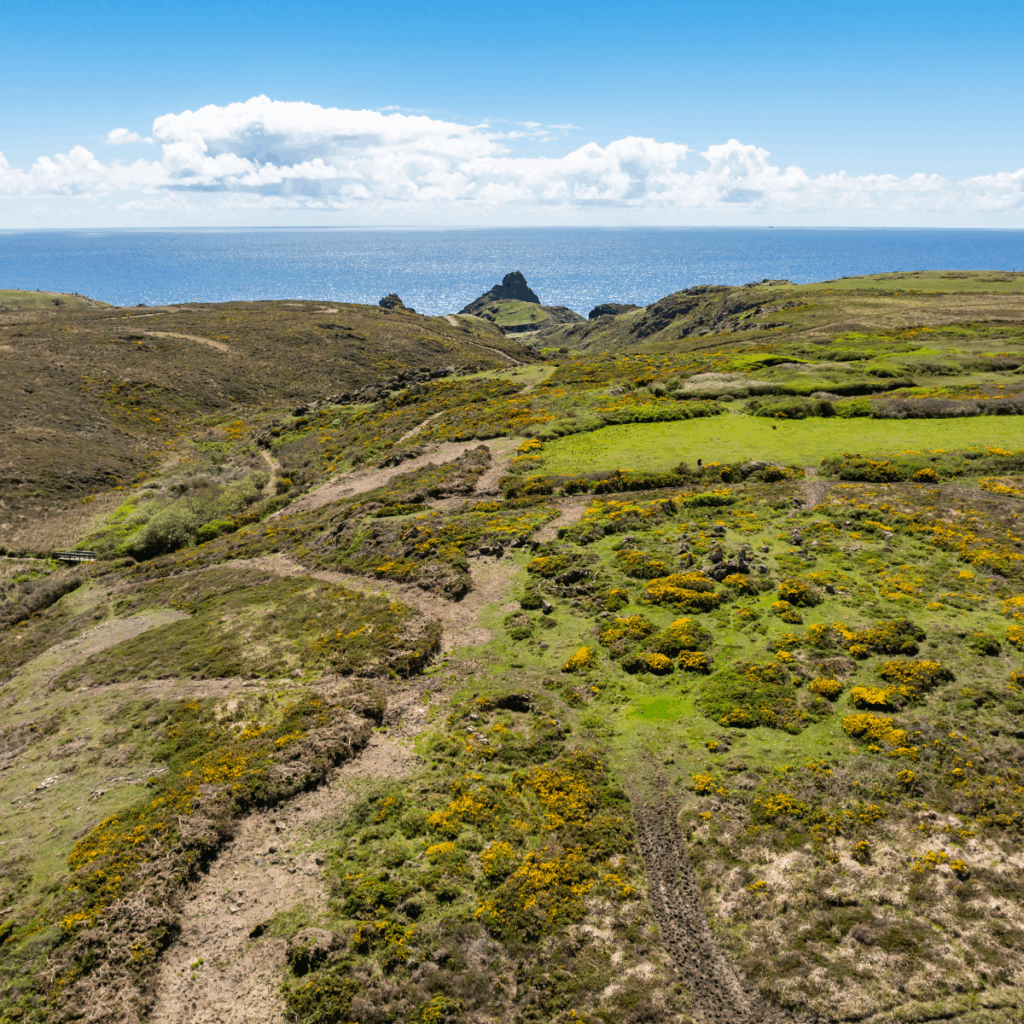
In Section 08 there are five sites included in the Cornwall National Landscape Monumental Improvement project. These are Gunwalloe Cliff Castle, Kynance Gate, Trebarveth Settlement, Dry Tree Barrow and the Goonhilly Barrow group.
Of these sites the Monumental Improvement project has most notably carried out conservation works at Kynance Gate. In September last year, the team completed two days of vegetation clearance at the site, as well as installing a new access gate and interpretation, not only at the monument site but also waymarking signs leading visitors from the nearby National Trust Car Park.
All of these monuments, as well as the other 35 monuments included on the project, will have their own dedicated webpage on the Cornwall National Landscape website, which will include various digital assets such as 360-degree panoramas, drone imagery, 3D Photogrammetry models, reconstruction illustrations plus much more!

The Cornwall National Landscape is involved in the Linking the Lizard Partnership, which is made up of a collective group of organisations including Cornwall National Landscape, Cornwall Wildlife Trust, Natural England, The National Trust, Wildlife Groundswell and the University of Exeter who are all working to ensure that The Lizard Peninsula continues to be internationally recognised for its rich and unique wildlife, landscape, cultural heritage and for its outdoor opportunities, which are welcoming to, and valued by, local people and visitors alike.
The Linking the Lizard Partnership collaborative work is centred around five key areas:
• Providing good access, recreation and interpretation for all visitors
• Improving the sustainability of our land management
• Supporting sustainable farming and horticulture
• Joining up, growing and improving the quality of wildlife habitats
• Helping reverse climate change while adapting to its many challenges
Find out more about the Linking the Lizard Partnership on the website by scanning the QR code with your smartphone camera


The Lizard Peninsula in Cornwall is one of the most ecologically unique areas in the UK, renowned for its rare geology, diverse habitats, and high concentration of rare species. Its underlying serpentine rock creates nutrient-poor, alkaline soils that support a range of specialized plant communities not found elsewhere in Britain.
The peninsula’s coastal cliffs, heathlands, and wildflower meadows host an array of rare and endemic flora. Notable plant species include Cornish heath (Erica vagans), which is found nowhere else in mainland Britain, and the wild asparagus (Asparagus prostratus), a nationally scarce species. The Lizard is also home to vibrant wildflower meadows that bloom with bloody cranesbill, spring squill, and sea thrift, creating a haven for pollinators.
In terms of fauna, the area supports rare invertebrates such as the silver-studded blue butterfly and the Lizard beetle (Clytus tropicus), as well as bird species like the chough, a member of the crow family with bright red legs and bill. Offshore, seals and basking sharks are often also spotted.
The Lizard’s unique ecology has led to much of it being protected as a National Nature Reserve, Site of Special Scientific Interest (SSSI), and is within Section 08 of the Cornwall National Landscape (AONB).

Find out more about Section 08 of the Cornwall National Landscape on the website by scanning the QR code with your smartphone camera

This article was co-written by the Cornwall National Landscape team and featured in The Cornishman, The Cornish Guardian and The West Briton.
